
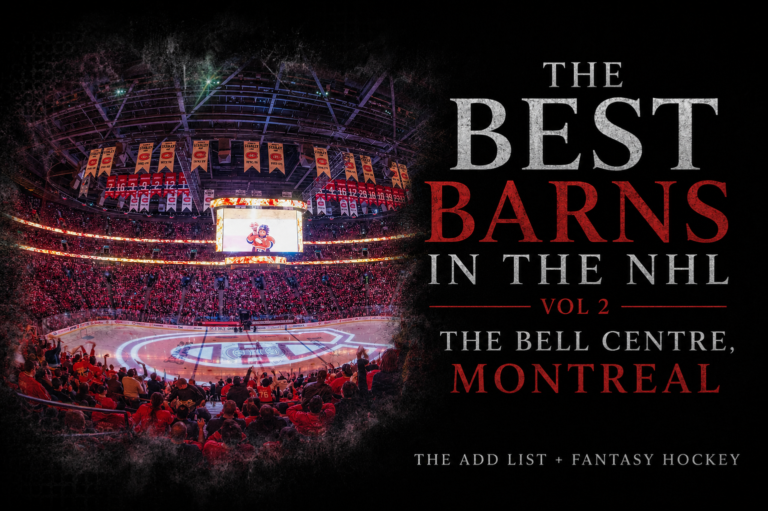

The Add List + | Arena Review Series
There are NHL arenas, and then there is the Vatican of the NHL, The Bell Centre.
Volume 1 set the bar high. Climate Pledge Arena in Seattle is a net-zero carbon certified masterpiece serving freshly shucked oysters at general admission and playing Nirvana every time the home team scores. Matching that was always going to be a challenge.
The Bell Centre is not trying to be Climate Pledge Arena. It is not trying to be anything other than what it already is… the largest, loudest, most historically loaded hockey arena in the NHL, sitting in the middle of one of the great sports cities on the planet. It does not need a rainwater harvesting cistern or a living wall. It has 24 Stanley Cup banners hanging from the rafters and twenty consecutive years of sellouts. That is its own kind of perfection.
The Building Itself: The Largest Barn in the League
Let’s start with the number: 21,273 seats. That is the largest capacity of any arena in the NHL — not by a little, but by enough to matter. When 21,000 Montrealers decide to make noise simultaneously, the sound does not just fill the building. It becomes the building. The Bell Centre is one of those rare arenas where the crowd is not background noise, it’s the identity.
Construction began on June 22, 1993, exactly 13 days after the Canadiens defeated the Los Angeles Kings at the Montreal Forum for their 24th and most recent Stanley Cup. There is something almost deliberately poetic about that timing: the last great moment at the old building, and then immediately breaking ground on the new one. The Bell Centre opened on March 16, 1996, with a 4-2 win over the New York Rangers. The Forum closed five days earlier. Montreal did not waste any time.
Originally called the Molson Centre, a name that suited the building’s relationship with Canada’s most iconic beer company, it was renamed the Bell Centre in 2002. It underwent a significant round of renovations in 2015: all seats replaced, concourses rebuilt, new restaurants added, public Wi-Fi installed, and the Avenue des Canadiens-de-Montréal out front converted into a pedestrian-only street. The building that exists today is modern, comfortable, and exceptionally well connected. It sits directly above two metro stations and links into Montreal’s famous underground city, meaning you can arrive from almost anywhere in the downtown core without ever stepping outside into a January night. That matters in Montreal.
Canadiens home games have been sold out continuously since January 2004. Every single one. If you are reading this and you have never experienced a Habs game at the Bell Centre with 21,000 people fully invested in every shift, that is not a gap in your sports travel resume — it is a gap in your life.
The Food: Poutine, HABSburgers, and a Market Worth Finding
Here is the honest truth about arena concessions in the NHL: most buildings are average at best. The Bell Centre sits comfortably above average, particularly since the 2015 renovations expanded the food program significantly.
The move to make first is finding the Marché on the M2 level. Marché is French for market — you will see that word all over Montreal and it always means something good — and the Bell Centre’s version delivers: Texas BBQ, tacos, sushi, poutine, and beers on tap, all under one roof inside the arena. This is where you go instead of standing in the standard concession line.
The HABSburger and HABSdog are arena staples that lean into the branding without apology, and both are worth the stop. The real star of the concession program, however, is Le Hot de MTL — the Bell Centre’s famous hot dog, which has developed a genuine cult following among regulars and is one of those things that sounds simple and tastes better than it has any right to. Tim Hortons is on site for the Canadians who require a double-double at intermission, which is a constitutionally protected right.
One important note: beer inside the Bell Centre runs north of $10 CAD. This is not unique to Montreal, but it is worth acknowledging before you budget for the evening. The Molson Canadian flows cold and freely throughout the building. Budget accordingly before you walk through the doors.
Inside the arena, La Cage aux Sports — one of the largest sports bars in Montreal — sits right on site for a pre-game drink with your tickets already in hand. The atmosphere in there before puck drop is exactly what you want.
The Food and Drink Outside: Where the Boys Trip Actually Happens
This is where Montreal separates itself from the competition — because the Bell Centre sits in a neighbourhood that was built, seemingly by design, for exactly this kind of evening. Crescent Street is ten minutes from the arena on foot and it is one of the great pre-game bar strips in North America.
But first, eat. Here are the spots that get it right without getting expensive.
Time Out Market Montréal, inside the nearby Eaton Centre, is the single best group option in the neighbourhood. One massive space, local and artisanal beers on tap, award-winning smash burgers, wings, nachos, and cocktails — all from some of the city’s top chefs under one roof. There is a giant screen showing the game, a full retro arcade setup including an NHL edition of Super Chexx Pro, and a cocktail menu inspired by Montreal’s own neighbourhoods. No reservation required, no dress code, no awkward math when splitting the bill. This is where a group of eight guys belongs two hours before puck drop.
Warehouse delivers exactly what the name suggests: zero pretension, strong drinks, and food priced between $5 and $15. Wings, nachos, burgers, poutine. Their own words describe it better than we could: “more nachos, more wings, and way less stressing over splitting the bill.” That is a restaurant that understands its audience completely.
Burger Bar on Crescent Street is the move for anyone who wants to eat something serious before a long night out. Fantastic burgers at a price that will not hurt anyone, plus a mac and cheese famous enough to make you question their identity as a burger establishment. The award-winning Hangover Burger is exactly what it sounds like.
Le Cathcart Restaurants et Biergarten at Place Ville Marie, about eight minutes from the arena, is a 35,000-square-foot food hall under a glass pavilion with a genuine Biergarten. Multiple food counters, happy hour running from 4 to 7pm, shared plates, and cold beer in a space big enough that your entire group can actually sit together.
The Beer and the Bars: Crescent Street Deserves Its Reputation
Crescent Street is your home base. Wall-to-wall pubs, patios open in season, live music spilling onto the sidewalk, and the kind of easy walking-distance bar-hopping that turns a good boys trip into a great one.
Hurley’s Irish Pub on Crescent is the anchor of the strip — known for the best Guinness in Montreal, fifty single malt scotches on the menu, and nightly live traditional Irish music that gets louder as the night gets later. It is the first stop and sometimes the only stop necessary.
Ziggy’s Pub, also on Crescent, is a Montreal landmark. A beautifully designed basement bar covered floor-to-ceiling in Canadiens memorabilia and photographs of famous customers going back decades. There is no food menu, but neighbouring restaurants deliver directly to the bar — for real. It is an experience that does not exist anywhere else. Keep your head up; it is reportedly a favourite stop for visiting coaches too.
Brutopia Brewpub Microbrasserie is a lively, three-level brewpub located in the downtown core of Montreal, Quebec. Known for its casual and cozy vibe, it is a staple for craft beer lovers with good eats and live music.
McKibbin’s Irish Pub on Bishop is the one with the deal that closes the argument: hold onto your ticket stub after the game and exchange it for a free shot of Jameson. Happy hour runs from 4 to 8pm, there are 20-plus imported beers on tap, and the Irish nachos are exactly what you need between bars. That is a pub that has thought seriously about what its customers actually want.
Ye Olde Orchard Pub on de la Montagne is a three-minute walk from the arena — the closest serious pub to the Bell Centre — and is perpetually packed on game nights for exactly that reason. Classic Irish pub grub, all the conventional Irish beers poured correctly, and an atmosphere that is already at game-night energy before you have left the neighbourhood.
The Goal Song: The Crowd Is the Goal Song
Every NHL arena has a goal song. Most of them are fine. Seattle has Nirvana. Montreal has something different — and in some ways more powerful.
The Bell Centre does not need a great goal song. It has 21,000 people who have been waiting their entire lives for the Habs to score. When a Montreal goal goes in, the building does not wait for a song cue to tell it how to react. The noise is immediate, physical, and total. The Habs logo lights up on the ice. The banners sway in the rafters. Twenty thousand people who care about this franchise more than they care about most things in their lives express that all at once.
It is one of the loudest things you will ever experience at a sporting event. It is worth the trip by itself.
The Verdict
The Bell Centre is the most storied arena in the NHL. Twenty-four Stanley Cup championships look down from those rafters at every game. Twenty consecutive years of sellouts. The largest building in the league, in the most passionate hockey city on the continent, surrounded by some of the best pre-game infrastructure of any arena in professional sports.
It is not making ice with rainwater. It is not serving freshly shucked oysters at general admission. But it is selling out every game in a building that seats 21,273 people because this city loves its team with a ferocity that no other market in the NHL has ever fully matched.
Go see a Habs game at the Bell Centre. Start at Time Out Market. Work your way down Crescent Street. Find Ziggy’s. Hold onto your ticket stub for the McKibbin’s Jameson..and when the horn sounds for a Montreal goal and the building goes completely off the rails around you, remember that this is what hockey was always supposed to feel like.
Volume 3 is coming.
Information sourced from the Bell Centre official website, Tourisme Montréal, Daily Hive Montréal, Time Out Montréal, Itinerant Fan, and Ticketmaster Bell Centre Guide, August 2026.
— The Add List +