
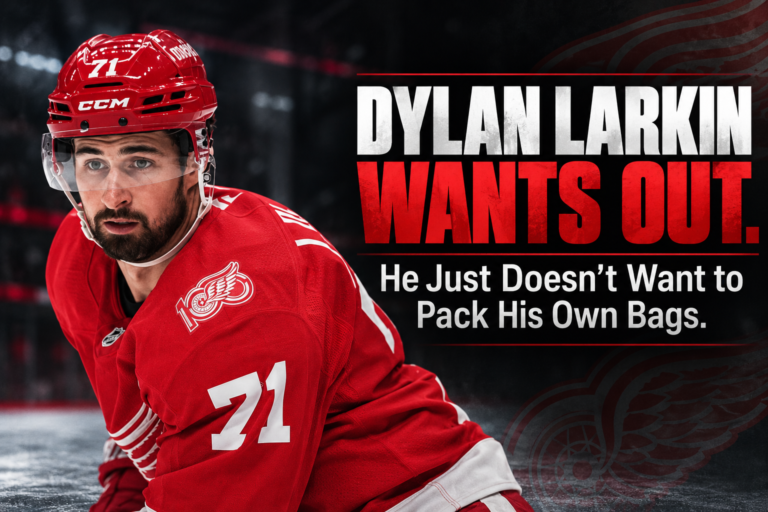

There was a time when Dylan Larkin was the face of everything Detroit hockey fans hoped the Red Wings could become again. He’s a Michigan kid who grew up in Waterford, starred at the University of Michigan, was drafted by the team he grew up watching, and wore the “C” for the franchise he loved. He climbed into the top ten in Red Wings history in goals and points. If any modern player was built to be a lifer, it was him.
Now he won’t even come to the rink.
On Thursday, Larkin’s camp informed the Red Wings that he was done playing for them. Detroit responded the only way it could: by suspending him without pay. It’s an ugly ending to a saga that has dragged on since June, when Larkin asked out after the franchise’s playoff drought hit ten years. He already lost the captaincy. He’s been booed at home. And now the man who was supposed to lead the Red Wings back to relevance is sitting at home, waiting for someone to rescue him.
Let’s call this what it is: entitled behaviour, plain and simple.
You Don’t Get to Order Off the Menu
Players are allowed to want out. Nobody is arguing that a ten-year playoff drought is fun, or that a competitor in his prime shouldn’t want to win. Wanting a trade isn’t the problem.
The problem is how Larkin has gone about it.
When he first asked to be moved, he gave the Red Wings a list of exactly three teams he would accept: Florida, Minnesota, and Vegas. That’s a sunny contender, a near-home Midwest option, and a desert powerhouse. He has since reportedly expanded the list to ten teams, but the principle hasn’t changed. Larkin wants to leave Detroit, but only on his terms, only to places he picks, and only when the deal suits him.
That isn’t a trade request. That’s a demand with a gift registry attached.
Yes, he has a no-trade clause, and yes, he negotiated it fairly. Nobody is saying the clause isn’t his to use. But there’s a basic contradiction in demanding out of an organization while simultaneously handcuffing that organization’s ability to get you out. If you want to be moved so badly that you’re willing to walk away from games and paychecks, then let the team move you. Let Detroit find the best deal, wherever it is, and get on with your career. You don’t get to burn the house down and then complain about the moving truck.
Instead, Detroit’s management is stuck. Interim GM Shawn Horcoff has been clear that he needs a real hockey return for a player of Larkin’s calibre, ideally an NHL center plus picks or prospects, and none of the offers from Larkin’s approved teams have met that standard. So the Red Wings are being asked to accept a bad deal because their former captain is impatient. That’s not fair to the franchise, and it’s certainly not fair to a fan base that cheered for him for a decade.
Loyalty Is on Life Support
What stings most about Larkin’s exit is what it says about the state of professional sports. Loyalty isn’t just fading. In a lot of locker rooms, it’s gone.
Hockey used to feel immune to this. The NHL was the league of lifers, the Yzermans and Lidstroms who stayed through good times and bad. But you can see the culture shifting. Pierre-Luc Dubois forced his way out of Columbus and then made it clear in Winnipeg that he had his heart set on Los Angeles. Matthew Tkachuk told Calgary he wouldn’t sign long-term, and the same with brother Brady. Now Larkin, the hometown kid, the guy who was supposed to be different, is following the same playbook.
Of course, the NBA perfected this years ago. Anthony Davis forced his way to Los Angeles. James Harden has orchestrated exits from not one, not two, but three franchises. Kevin Durant asked out of Brooklyn after the Nets bent over backwards to build around him. And Damian Lillard might be the perfect parallel to Larkin. He demanded a trade from Portland and made it clear Miami was where he wanted to go. Portland traded him to Milwaukee instead. The team held its ground, made the best deal available, and moved on.
Detroit should take notes.
So Who’s to Blame?
It would be lazy to put every bit of this on the players. Management deserves its share of scrutiny. Ten years without a playoff appearance is a long time for any player to be patient, and organizations that make promises about “the rebuild” and fail to deliver shouldn’t be shocked when their stars run out of faith. Players also remember how teams treat them. They’ve watched franchises trade loyal veterans the moment it was convenient, with no warning and no sentimentality. Loyalty was never a one-way street, and plenty of front offices helped kill it.
But that only goes so far.
The bigger shift is in player attitudes and in how much power players now hold. Today’s stars have the leverage, the money, the agents, and the social media platforms to dictate their futures, and many of them have stopped seeing a contract as a commitment. A deal used to mean you’d show up and play for the length of it. Now it often means you’ll play until you’d rather be somewhere else. When things get hard, the response isn’t to lead your team out of it. It’s to call your agent.
That’s what makes Larkin’s case so disappointing. He was the captain. Captains are supposed to be the last ones off the ship, not the guys threatening to sink it unless they get their preferred lifeboat.
The Bottom Line
Dylan Larkin has every right to want a fresh start. What he doesn’t have the right to do is hold an entire franchise hostage while he waits for his preferred destination to come through. If he truly wants out of Detroit, he should loosen his grip on that list and let the Red Wings do their jobs.
Detroit, meanwhile, should hold firm. Don’t take a bad deal just to make this go away. Larkin made this mess. Let him sit with it.
Loyalty may be dead in sports, but accountability shouldn’t be.