
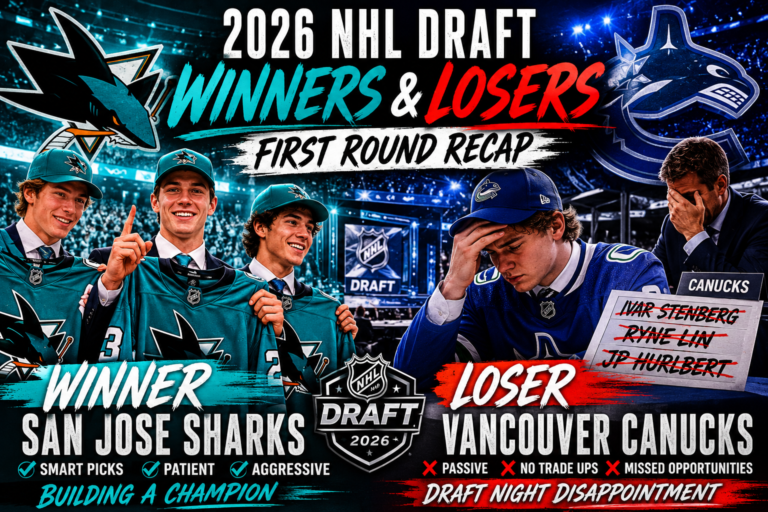

The first round of the 2026 NHL Draft is in the books, and not everyone walked out of KeyBank Center feeling the same way. Some franchises came to Buffalo with a plan, executed it with aggression and precision, and left with a haul that will define their trajectory for the next decade. Others came with the same passive energy they have been bringing to every important moment for years — and left with exactly what passive franchises deserve.
Here is the definitive breakdown of the night’s biggest winner and biggest loser.
BIGGEST WINNER: San Jose Sharks
Smart. Aggressive. Relentless. This is What Elite Management Looks Like.
Let’s be clear about something before we start: the San Jose Sharks came into tonight’s draft holding two picks in the top nine. They left with three first-round picks, two of them blue-chip defenders, bookending one of the most complete and forward-thinking draft nights any franchise has had in recent memory.
It started at second overall, where general manager Mike Grier and his staff made the decision that had the hockey world buzzing from the moment the lottery results were announced in May. With Chase Reid on the board — a defenceman widely considered a franchise-calibre blue line anchor — the Sharks looked left, saw Ivar Stenberg still available, and made the boldest pick of the night.
They took the forward.
Not because they do not need defensive help. They do. They took Stenberg because Ivar Stenberg is quite possibly the most complete player in this entire draft class, and franchise players at that level do not come along very often. The SHL Rookie of the Year. The Swedish Junior Player of the Year — an award previously won by Henrik and Daniel Sedin. A gold medalist. A player who, according to The Hockey News, put together one of the most productive seasons ever in the Swedish League for a draft-eligible player. The Sharks looked at the board, identified the best player available, and took him without blinking.
And then — and this is where the night became truly remarkable — they were patient.
San Jose had the ninth overall pick. They did not reach. They did not panic. They sat back, let the board come to them, and when Keaton Verhoeff was still available at nine, they took the right-shot defenceman with the enormous frame, the elite skating, and the top-pairing ceiling that Celebrini and Stenberg’s offensive game will require beside them. The Sharks capped an incredible two-pick day, and hockey observers were already calling them winners of the draft before the night was even half over.
But they were not done.
San Jose acquired the 21st overall pick from Philadelphia — sending back the 27th, 62nd, and 120th overall picks — and used it to select Ryan Lin, a smooth, transitional defenceman out of the Vancouver Giants who led his team in assists with 43 to go along with 14 goals. Lin is already committed to the University of Denver, where he will develop before making his professional debut. He is, by any reasonable assessment, a steal at 21.
Ryan Lin is a Richmond, British Columbia native who is smooth, intelligent, and exactly the kind of player the Sharks needed to add depth to a blue line that is now starting to look genuinely formidable. And in a moment that will not be lost on anyone watching, San Jose scooped him right out from under the Vancouver Canucks — who had been sitting at 24th overall watching their draft board dissolve pick by pick, and who almost certainly had Lin circled on their list.
Step back and look at what the San Jose Sharks did tonight. They selected Ivar Stenberg — arguably the best player in the draft — at second overall. They grabbed Keaton Verhoeff at ninth, filling the defensive need they passed on at second. They traded up four spots to 21st to steal Ryan Lin before Vancouver could get their hands on him. Three first-round picks. Two elite defenders flanking a franchise forward who may be the first player from this class to play in the NHL next season.
Macklin Celebrini. Will Smith. Ivar Stenberg. Keaton Verhoeff. Ryan Lin. The San Jose Sharks are no longer a team people laugh at. They are a team people are going to fear — and the teams in the Western Conference who are not paying attention should start.
This draft was not luck. It was not circumstance. It was the product of elite management, clear-eyed scouting, and the organizational confidence to make aggressive moves when the moment demands it. It is hard to imagine this team not winning a Stanley Cup in the coming years. The foundation being built in San Jose right now is that good.
BIGGEST LOSER: Vancouver Canucks
Passive. Quiet. Did They Even Attend?
The Vancouver Canucks finished last in the NHL this season. Dead last. In one of the most passionate and demanding hockey markets in the world, they lost more games than anyone else and arrived in Buffalo with the third overall pick and the 24th overall pick — two legitimate opportunities to begin the process of restoring some dignity to a franchise that desperately needs it.
They wasted both of them. Not in terms of player selection — Caleb Malhotra at third overall is a defensible pick, and the hockey world knows it. One scout called him a franchise number-one centre, and his 84 points in 67 OHL games followed by 26 points in 15 playoff games this season backs that assessment up. But taking Malhotra because everyone else you wanted was gone is not a strategy. It is what happens when you have no strategy.
Because here is the truth about the third pick: the Canucks did not want Caleb Malhotra. They wanted Ivar Stenberg. The Sharks’ selection of Stenberg at second overall was described as “a tough loss” for Vancouver, with the Swede finishing the SHL season with 33 points and drawing enormous interest from the Canucks’ scouting staff. Stenberg was Vancouver’s guy. San Jose took him, and the Canucks were left scrambling.
Fine. That happens. The lottery determines the order, and you cannot control what teams ahead of you do. What you can control is what happens next. And what happened next at pick 24 was nothing short of a disaster in slow motion.
First, Ryan Lin — the smooth, offensively gifted defender from the Vancouver Giants, a Richmond native who was by most accounts a perfect fit for the Canucks’ blue line — was scooped by San Jose at 21st overall. San Jose, who had already made their two picks in the top ten, traded up specifically to take Lin away from Vancouver. The Sharks did not need to make that move. They made it because they are aggressive, because they had the assets, and because they recognized that Lin was the right player at the right price.
Then it got worse. JP Hurlbert — the highly-regarded forward out of the Kamloops Blazers and a player who represented a realistic consolation at 24th — was gone at 23rd, one single pick before Vancouver was on the clock. Detroit, having acquired Boston’s pick via Utah, walked up to the podium and took Hurlbert, leaving the Canucks to watch their second option disappear by a single selection.
Vancouver ultimately selected Adam Novotny — a versatile winger with a solid two-way game and good hockey sense — and Novotny may well develop into a useful NHL player…maybe. But standing at 24th overall, with Ryan Lin gone and JP Hurlbert gone, selecting the best player remaining on the board is not a win. It is damage control.
And here is the part that cuts the deepest: Vancouver had the draft capital to trade up. They had the assets. They chose not to use them. While San Jose was acquiring picks and moving up the board with the confidence of a franchise that knows exactly what it is doing, the Canucks stood at the podium twice and waited for the game to come to them.
It did not.
Newly hired general manager Ryan Johnson was supposed to signal a new era of decisive, forward-thinking management for a franchise that has too often been defined by hesitation and half-measures. Tonight was his first major test on the biggest stage of his tenure to date. The result was not encouraging.
This is what separates elite franchises from mediocre ones. The Canucks are mediocre — not because they lack talent in their pipeline, not because their market is wrong, and not because the rebuild cannot work. They are mediocre because when the moment demanded boldness, they offered passivity. When the game required aggression, they watched from the sidelines.
Vancouver finished last in the league. Their fanbase expects better. Their market demands better. Tonight, they deserved better.
Sadly, that is not what they got.
– The Add List +